
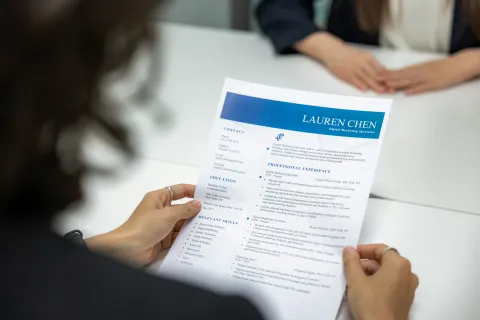

Create your CV
Your CV is your first introduction to a potential employer. It should make a clear case for your skills and experience, and give them a reason to invite you. A good CV significantly improves your chances of securing an interview and thus of getting a job.
How to write a Dutch CV
The Curriculum Vitae is the most important step in finding a job in the Netherlands. Your CV is a marketing tool to get noticed by recruiters and trigger a conversation during the job interview. There is no one-size-fits-all rule or format when it comes to writing a CV. Your CV should be original and reflect your personality. Most CVs in the Netherlands follow a standard formatting structure to be concise and effective.
-
1
Personal details
The first section should contain all of your relevant personal information.
- First and last name.
- Location: your home address is not required, but city and country make it easier to know if you are already in the Netherlands.
- Date of birth is appreciated but not obligatory.
- Nationality: add if you need sponsorship or already have a residence and work permit.
- Contact details: including a email address, telephone number and LinkedIn profile link.
- Passport-size picture is common in the Netherlands. You can often take professional pictures at career fairs.
- Add a personal profile to summarise your experience, key achievements and goals.
-
2
Work experience
- List your most recent work experience in a reverse chronological order, starting with your most recent position. Include only professional experience relevant to the position you are applying for.
- For each position, list the came of the employer, your job title, employment period and main tasks and responsibilities. Highlight some key achievements in concise sentences with active verbs.
- If you have little work experience, you can include academic courses and projects you participated in or include part-time, summer and volunteer work experience if it is relevant to the job your are applying for.
- You can include parttime and voluntary work experience if it is relevant to the job.
- Use bullet points to create a clean, concise and structured look.
-
3
Education
- List your academic qualifications. Your highest degree should be listed first. Include the type of the degree, name and location of the university, programme name and period.
- If you have limited work experience, you can include more achievements, such as average final grade, group projects, trainings, conferences and title of your thesis.
- If you are a recent graduate you may want to lead with your academic experience and follow with your part-time work experience.
- Make sure to adapt your CV if you apply for academic or industry positions. Conferences, paper titles and published papers may be less relevant for company positions.
-
4
Skills
- List skills, achievements and other relevant experience not mentioned before, such as computer skills, driving licence, interests or hobbies.
- Do not overdo it with listing hobbies or travel experience. It does not cover up limited relevant work experience.
- List your language skills and mention your current level of proficiency (in words and language scores like A1/B2/C1). Especially your level of English and Dutch are important as indication if you meet the language requirements of the job you are applying for. Any Dutch skills show you are making an effort to adapt to living in the Netherlands and indicate you are here to stay.
-
5
References
- References and copies of diplomas are usually not required when you apply for a job in the Netherlands.
- Employers may ask for references and diplomas later in the recruitment process.
- Students and graduates can list academic teachers or supervisors for their internships or volunteer work. One of the reasons why internships and volunteering can help with getting a job in the Netherlands.
- Be sure to ask for a letter of recommendation after finishing an internship. You may need it in the future.
- Contact your reference in advance if you include them so they know someone may contact them.

Tips for writing a Dutch CV
- Tailor your CV as much as possible for each job application.
- Recruiters scan CVs within seconds. CVs in the Netherlands must not exceed two pages. One-page CVs are the standard when applying for entry-level positions.
- Keep your CV short, as simple as possible and easy-to-read. Use bullet points. Be sure to avoid spelling, punctuation or grammatical mistakes. Let someone else proofread.
- A CV and cover letter work together. Make sure the facts are the same. Your CV shows you are qualified. Your cover letter reflects your motivation and suitability for the job.

Applicant Tracking Systems (ATS)
ATS is software used by employers to store, organise and filter job applications. Digital tech and multinational companies are often using ATS to scan your CV based on keywords related to skills, experience and qualifications before a recruiter ever sees it. Building an ATS-friendly CV is essential in the current job market.
ATS recognizes exact word combinations, so use the same wording as in the job posting. Use standard fonts like Arial or Calibri. Upload your CV in a Word or PDF format. Use a single-column format. Unless you are a graphic designer, avoid complicated designs, images and fonts. Do not use a font size smaller than 10 points. Make sure your CV is not longer than two pages.